International supplier of functional membrane separation materials and solutions
Contact Us
Chinese | English
Membrane technology changes life
Home
About Us
Company Profile
Honor
Products
Ammonia Removal Membrane Contactors
Membrane Distillation Contactors
Degassing Membrane Contactors
Carbon Capture Membrane Contactors
Applications
Ammonia Removal Case
Membrane Distillation Case
Carbon Capture Case
Knowledgebase
Blog
Experimental and Project Report
FAQ
Join Us
Download
Ammonia Removal Membrane
Degassing Membrane
Membrane Distillation
中文版
English
新闻资讯
Frequently Asked Questions
2026-06-26
Beyond Ammonia Removal: Applications of PTFE Membrane Contactors for Acid Gas and Amine Off-Gas Treatment
2026-01-05
Treatment Processes for High Ammonia Nitrogen Wastewater
2025-05-13
Membrane-Based Ammonia Removal: An Efficient Solution for High-Ammonia Wastewater Treatment
In industrial wastewater treatment, high ammonia nitrogen wastewater treatment is difficult, traditional blowing off, stripping tower and other methods have a large area, high energy consumption, complex operation, poor scalability and other problems. Membrane deamination technology with excellent performance and flexible application is becoming an ideal choice for enterprises to treat high ammonia nitrogen wastewater.
2025-05-09
Etching Wastewater Ammonia Removal Membrane System Project for an Optoelectronics Company
An optoelectronic technology limited company in the production process produces a large number of high ammonia nitrogen wastewater, in order to realize the wastewater discharge standards. The enterprise adopts advanced de-ammonia membrane technology to remove ammonia from the wastewater to ensure that the effluent quality meets the relevant environmental standards.
2025-03-31
Why more and more customers using the air stripping methods are switching to membrane ammonia removal technology
More and more customers who previously used the air stripping method for ammonia-nitrogen wastewater treatment are switching to membrane-based ammonia removal technology. This is mainly because membrane-based ammonia removal offers significant advantages in economic efficiency, removal performance, environmental benefits, and adaptability compared to traditional air stripping.
2025-03-17
Challenges and Issues of Using Phosphoric Acid as an Absorption Liquid in Membrane-Based Ammonia Removal
While phosphoric acid can theoretically be used in membrane-based ammonia removal, its rapid pH fluctuation, limited absorption capacity, unstable reaction products, membrane fouling risks, and poor economic viability make it less suitable for practical applications. Currently, sulfuric acid (H₂SO₄), nitric acid (HNO₃), and hydrochloric acid (HCl) are more commonly used due to their higher efficiency and stability. When selecting an absorption liquid, it is essential to consider chemical stability, ammonia removal performance, and long-term operational costs to optimize the overall process.to resist.
2024-11-20
Ammonia Removal By TMCS Technology
We're excited to introduce you to TMCS (TransMembrane ChemiSorption) technology, which is based on SCINANO’s PTFE hollow fiber membrane contactor.
2024-07-23
Experimental Report III on PTFE Membrane Deamination Test at High Temperature
When the amount of alkali added to the raw water increases, the ammonium root in the raw water will fully react with the hydroxide to generate ammonia, which increases the air permeability of the deammoniated membrane, resulting in a decrease in the ammonia nitrogen produced in the water. When the influent flow rate decreases, the air permeability per unit area of the deamination membrane increases, and the deamination effect is enhanced, which causes the decrease of ammonia nitrogen in water production.
2024-07-18
Experimental Report on High Temperature PTFE Membrane Deamination Test II
Under the conditions of raw water temperature 70 ℃ and acid absorption solution pH = 1, when the alkali addition amount of wastewater is about 1.5g/L(pH = 9.03) and the raw water flow rate is 13.2L/h, the ammonia nitrogen content of water produced by primary membrane deamination after stable operation is 9.5mg/L, which meets the ammonia nitrogen requirement of drainage. The raw water is fed into 20L, and the sulfuric acid absorption solution is reduced by about 0.2L. In order to ensure the stable discharge of effluent up to standard, the alkali addition amount can be controlled to 1.5g/L, the raw water flow rate to 12.0L/h, and the ammonia nitrogen content of the water produced by the primary membrane deamination after stable operation is 7.2mg/L.
2024-07-16
Experimental Report on High Temperature PTFE Membrane Deamination Test
In this small-scale experiment, under the conditions of raw water temperature 70 ℃, alkali addition amount of wastewater about 2g/L(pH = 9.29), and acid absorption solution pH = 1.5: when the raw water flow rate is 16.8L/h, the ammonia nitrogen content of water produced by primary membrane deamination is 7.4mg/L after 10 minutes of stable operation, which meets the ammonia nitrogen requirement of drainage.
2024-07-11
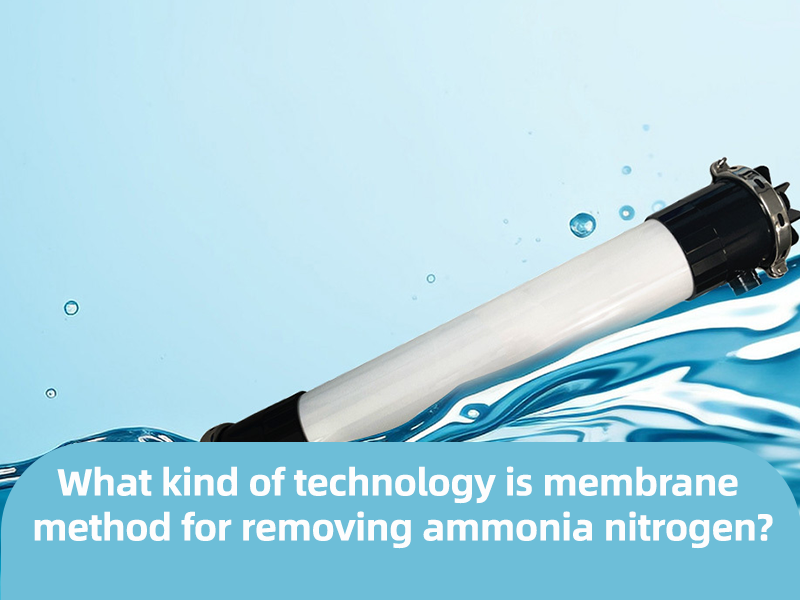
What kind of technology is membrane method for removing ammonia nitrogen?
Membrane deamination is an advanced water treatment technology designed specifically for the efficient removal of ammonia nitrogen from water.
2024-06-21
What is the difference between ammonia removal membrane and reverse osmosis membrane?
A reverse osmosis membrane is a semi-permeable membrane that allows water molecules to pass through it, but it blocks most of the dissolved salts, organics, bacteria and pyrogens. On the other hand, membrane contactors can only effectively remove gases such as oxygen, carbon dioxide, and ammonia in water, but cannot eliminate ions, bacteria, organic matter, or suspended solids.